

Notes on Easter
Faith, lamb cakes, and post-traumatic growth.

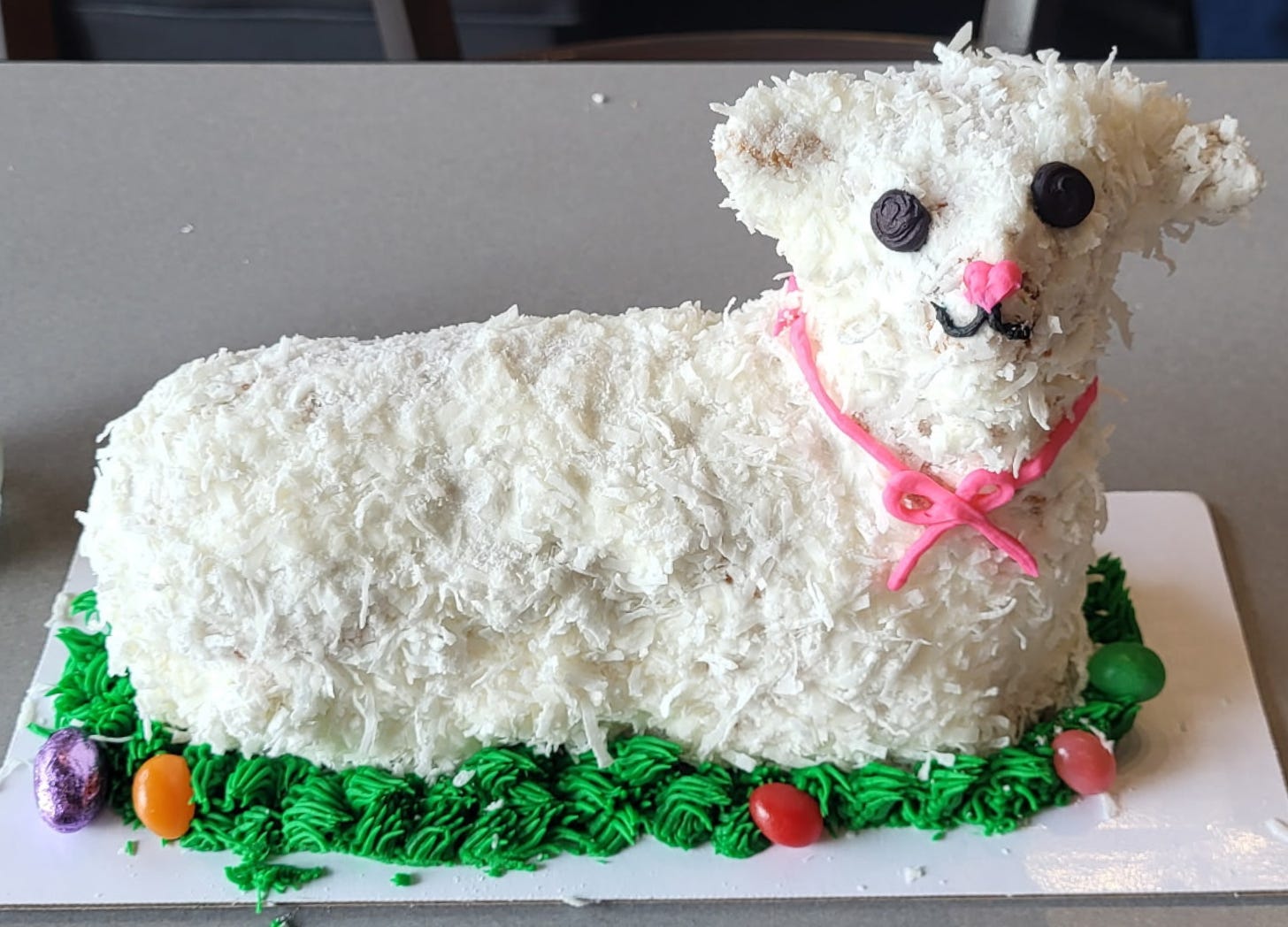
Have you seen the lamb cake? My family has ordered one from the same deli since the 1950s.
It’s an Easter dessert made from cake baked in a lamb-shaped mold, frosted with white buttercream icing, blanketed with shredded coconut to resemble wool, and dotted with two soulless black gummies for the eyes.
Children squeal as they watch the lamb cake’s head cut off and served on a plate. For some, it’s the first execution they’ll ever witness. I know it was mine.
But lets be honest, Easter is not shy on executions.
Despite the symbology of spring—bunnies, eggs, pastel colors—the story at the center of Easter begins on Good Friday with the arrest, conviction, and crucifixion of Jesus of Nazareth, a profoundly brutal affair. One that highlights what Catholic theologian’s call Jesus’s “hypostatic union,” being both divine and human in one person. That Jesus suffers as a man gives the story a deeply humanistic resonance.
We understand the weight of Jesus’s suffering because each one of us has been touched by suffering, often in life-altering ways. I know I have.
I can’t say that cancer was my first encounter with life-altering suffering. It was another trial which has that distinction: my struggles with bipolar disorder and alcohol use disorder. It was among the darkest moments of my life, and I’ve written about this extensively elsewhere.
Even so, it set off a series of events that ultimately led to better things. I went to therapy, took therapeutic medications, focused on sleeping, eating, and moving, and began my study of wellness and positive psychology. It gave birth to my new mission, which was to help teach others to drink mindfully and, perhaps, help those who were struggling with their alcohol use find a path of equanimity.
There’s a psychological concept that captures this kind of transformation: post-traumatic growth. Psychologists Richard Tedeschi and Lawrence Calhoun developed the idea to describe how, after experiencing trauma or significant adversity, a person can undergo positive psychological change. This growth may include a deeper appreciation for life, more meaningful relationships, new possibilities, greater personal strength, or a renewed sense of purpose.
Not to be outdone, last year I developed a rare blood cancer that has challenged my physical self as much as bipolar disorder and alcohol use disorder had challenged my psychological self. As I begin to heal, I can feel the spring buds of renewed growth.
It has led me to more deeply explore my Catholic faith, apropos for the season but also deeply entwined with my experience of cancer and the subsequent stem cell transplant. There were nights in the hospital where I was left alone with my pain, where nurses and doctors had said and done all they could, where the medications offered no relief. My inner reserves were depleted, and I had nowhere to turn.
It was there, in those moments, that I imagined the agonizing sacrifice of Christ and found a pervading sense of calm.
This calm came from a realization that, despite our fragile and sometimes helpless bodies, there’s a great love at the center of this mystery of life. It’s the very love of which the universe is composed, as Pierre Teilhard de Chardin reminds us. Though I sometimes struggle to live by my faith and articulate its meaning in my life—perhaps because so much of it is nonverbal, existing in inexpressible feeling—I can still see the primacy of this love.
It’s not abstract. It’s something we can come to know, in part, through our presence with one another and how we make that love visible, such as caring for each other in the face of suffering.
It’s also present in the rituals we return to year after year—embodied practices that carry a silent understanding of their meaning. In performing them, we remember what has come before. While presence is how we show love in the here and now, memory is how we carry it forward in one another’s absence.
This brings me back to the matter of the lamb cake. Each year, my mom buys this silly-looking thing during Easter, and each year it becomes, honestly, the brunt of our jokes. We pass around lamb cake memes and laugh at the worst examples we can find on social media.
Regardless, my wife asked me the other day if I’d carry on the tradition of the lamb cake when it became my turn. After some thought, I told her I would.
Writing is part of my therapy. By becoming a founding member or yearly subscriber, you can help me focus on both my recovery and the work I love.
If you’d like, another option to support me is by supporting organizations battling blood cancers such as Blood Cancer United. Or, consider joining the registry to donate stem cells.
Either way, I’m so grateful to you, my readers, and will continue to share my story along with tips on mindful drinking and evidence-based advice on well-being.
Beautiful Derek! (My grandma always made a lamb cake for Easter!) As hard as things are in our lives, I believe that many times they are reminders to come back to our faiths or a power higher than ourselves. Peace to you in your continued journey! Enjoy the lamb cake 😉
I love this, Derek. Wonderful thoughts yet again.